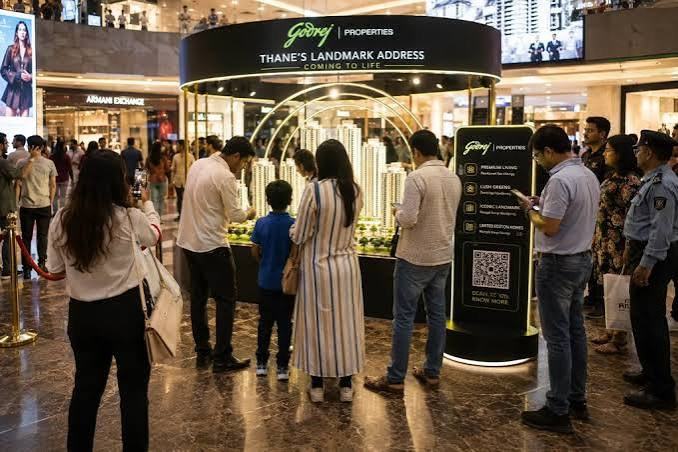
Every brand competing for attention in Delhi NCR is fighting the same basic problem: digital ads get scrolled past in under a second, and even a well-produced outdoor campaign competes with traffic, noise, and a hundred other things pulling at someone’s attention. Malls solve a version of this problem that’s easy to underestimate until you actually look at the environment they create — a captive, unhurried audience that’s already in a browsing, spending mindset, inside a controlled space with built-in security and infrastructure.
There’s also a very practical, very Delhi-specific reason malls work as an activation venue: the climate. Summer heat that regularly pushes past 40°C, monsoon downpours, and winter air quality that keeps people indoors for stretches of the year all make outdoor activations a genuine gamble for a meaningful chunk of the calendar. A mall activation runs on schedule regardless of what’s happening outside, which matters more to a brand’s planning timeline than it might initially seem.
What makes mall activations in Delhi NCR logistically distinct from a standalone event isn’t the creative concept — it’s everything around it. Setup and teardown happen within windows defined by mall management, not by the brand’s own schedule. Foot traffic has to be actively planned around rather than assumed, since regular shoppers are still moving through the space the entire time. And permits, insurance, and structural or electrical approvals from mall management aren’t a formality; they’re a real, non-negotiable part of getting an activation approved in the first place.
The formats that work well inside this environment tend to share a common trait: they’re designed for someone walking past, not someone who’s already decided to engage. Product launches and live demos work because they create a moment of genuine novelty in an otherwise predictable shopping trip. Seasonal and festive campaigns — Diwali, New Year, back-to-school — work because they tap into a mood the shopper is already in, rather than asking them to switch gears entirely. Interactive installations, photo zones, and sampling stations work because they invite a few seconds of participation rather than demanding sustained attention. Automotive and showroom-style displays are a particularly good fit for malls specifically, since a mall environment gives a vehicle launch or dealership promotion access to a far larger, more varied audience than a closed showroom event ever could.
Measuring whether a mall activation actually worked is more straightforward than it sounds, provided it’s planned for from the start rather than figured out afterward. Footfall and dwell time at the activation zone, sampling or trial conversion where relevant, and social sharing generated on-site are all measurable if the activation is built with simple tracking in mind — a branded photo zone, a quick interaction that doubles as a data point, a sign-up or sampling counter that logs numbers. Brands that build this in upfront walk away with a real answer to “did it work,” not just a gut feeling.
Budget for a mall activation tends to scale with mall tier and footfall more than with the creative concept itself. A premium, high-traffic mall in a major commercial district commands a higher activation fee than a neighbourhood mall, simply because of the volume and demographic of shoppers passing through. It’s worth matching the mall tier to the actual target audience rather than defaulting to the most prestigious available location — a budget-conscious sampling campaign often performs better, and costs considerably less, in a high-footfall mid-tier mall than in a luxury flagship property.
Timing matters almost as much as location. Weekend footfall in most Delhi NCR malls runs significantly higher than weekday footfall, and the festive season — Diwali through New Year in particular — sees a sharp spike in both traffic and activation demand, which also means premium pricing and earlier booking deadlines for popular mall slots. Planning a campaign around this calendar, rather than assuming any week works equally well, makes a real difference to how many people actually walk past the activation.
Choosing the right mall is its own decision, separate from choosing the right activation concept. A mall’s typical shopper demographic — age range, spending power, family versus young-professional skew — should match the target audience for the campaign, not just the mall’s overall prestige or footfall numbers. An agency with experience across multiple Delhi NCR malls can usually speak to this directly, recommending a property based on actual audience fit rather than defaulting to whichever mall they’ve worked with most often.
A mall activation also rarely needs to exist in isolation. Brands running a broader push — a product launch supported by a parallel corporate event management company effort, or a B2B conference happening on the same timeline — often get more value out of an activation when it’s planned as part of that wider calendar rather than as a one-off. A consumer-facing mall activation can extend the reach of a primarily B2B conference, putting the same campaign message in front of an entirely different audience segment without duplicating the creative work from scratch.
This is particularly relevant for brands that also run formal conference planning events — a leadership summit or industry conference reaches a relatively narrow, invited audience, while a parallel or follow-up mall activation reaches the broader public the conference’s messaging was ultimately meant to influence. Treating these as connected rather than separate line items in the marketing calendar tends to get more mileage out of both.
Malls aren’t the right venue for every brand moment — a confidential internal announcement or a small executive briefing clearly belongs elsewhere. But for any brand trying to create a genuine, memorable, in-person moment with a real consumer audience in Delhi NCR, a properly planned mall activation reaches more people, in a more controlled and weather-proof environment, than most alternatives at a comparable budget.