This is the story of how a move to Trustpilot’s paid platform was followed by large-scale review removals, declining ratings, and a long search for review-level explanations that the company says it never received.
Trustpilot is one of the largest review platforms in the world. Millions of consumers use it to read customer feedback, compare businesses, and make purchasing decisions. Businesses, in turn, rely on it to build trust and showcase customer experiences.
Today, the platform hosts more than 330 million reviews.
Over the years, however, a growing number of businesses have raised concerns about how reviews are moderated on the platform. Some have questioned the removal of genuine reviews, the lack of transparency around moderation decisions, and what they see as increasing pressure to move towards paid subscription plans.
Independent reports, consumer complaints, and discussions across business forums have highlighted similar experiences. These accounts have led some businesses to question whether the system operates on a pay-to-play model and whether review platforms are striking the right balance between fraud prevention, fairness, and accountability.
Like many businesses that depend on customer feedback to build trust, Thrillophilia has always viewed reviews as much more than ratings on a page. Every review reflects a traveller’s experience and the confidence they placed in the company while planning their trip.
Over the years, thousands of travellers have shared genuine feedback about their journeys with Thrillophilia, and those reviews have played an important role in building credibility with future customers.
Looking back at Thrillophilia’s journey on Trustpilot helps explain how these concerns began to emerge.
For a long time, Thrillophilia maintained a Trustpilot rating of around 4.2 while collecting reviews directly from customers. As part of its regular feedback process, travellers were encouraged to leave reviews after completing their bookings, something that thousands of businesses around the world do every day.
Thrillophilia simply facilitated that process for customers who wanted to share their experiences.
However, after nearly two years of collecting reviews and receiving direct feedback from customers, the company noticed that its average rating had gradually fallen to 3.6. That was when the team decided to investigate what was happening.
How Trustpilot Sells Paid Plans to Bring Reviews and Ratings
At the time, the team was watching ratings continue to fall despite putting significant effort into collecting customer reviews. Naturally, the next step was to ask Trustpilot for answers.
When Thrillophilia first raised the issue, the company was informed that reviews collected outside Trustpilot’s official invitation mechanisms faced greater challenges during automated verification checks.
Around the same time, Trustpilot’s sales team approached Thrillophilia with a proposal to upgrade to a paid subscription plan.
Trustpilot’s reputation in the market, combined with Thrillophilia’s confidence in the authenticity of its traveller reviews and the ongoing conversations with the platform, made the decision feel good at the time.
The company decided to move ahead with the upgrade.
What followed was not what the team expected.
At the time of the sale, Trustpilot’s team spoke about improved brand visibility and rating growth. For a brief period, things appeared to improve. But before long, the company began seeing reviews disappear and ratings decline once again.
It all began in August 2024, when Thrillophilia subscribed to Trustpilot’s paid Plus plan at an annual cost of approximately £3,108.
During the sales process, written communication from Trustpilot stated that genuine reviews collected correctly and in accordance with platform guidelines would not be removed.
Based on those assurances, Thrillophilia followed the instructions provided by the platform and ensured that every review invitation was sent only to customers with verified booking references and PNR numbers.
The company eventually moved entirely to Trustpilot’s Automatic Feedback Service (AFS). Even after making that transition, reviews continued to be removed.
At that point, the team reached out again, expecting that there would be a clear explanation for what was happening.
For a while, things appeared to stabilise.
Thrillophilia’s rating climbed back to around 4.1, but behind the scenes, reviews continued to disappear and ratings continued to fluctuate. At the time, the team did not realise that what seemed like isolated incidents would eventually have a much bigger impact on the company’s public reputation.
That was particularly difficult to accept because maintaining credibility on the platform was one of the key reasons for subscribing to the paid service in the first place. Seeing that trust slowly erode felt like a serious setback.
Despite this, the company continued trying to resolve the issue.
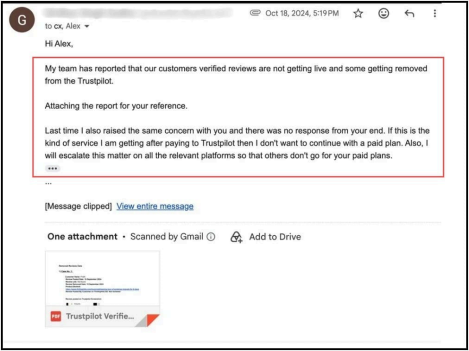
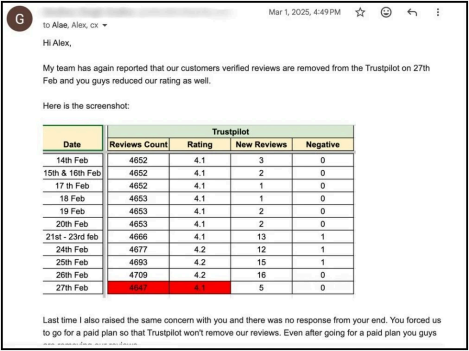
Throughout 2024 and again in 2025, Thrillophilia raised multiple support tickets with Trustpilot in an attempt to understand why reviews were being removed and what could be done to address it.
According to the company, the responses that came back were largely templated and automated, with little or no human intervention in the process.
Positive Reviews Continued to Disappear
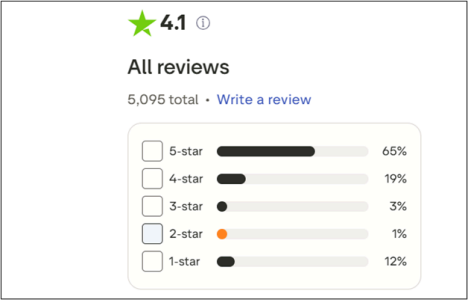
Even with reviews being removed and support conversations ongoing, the public rating somehow managed to remain around 4.1 for some time.
A screenshot taken on 19 August 2025 showed that positive verified reviews made up 65% of the company’s 5,000+ reviews on the platform.
Mass Review Removals, Falling Ratings, and Very Few Answers
As the second year of the subscription approached, things changed quickly.
Positive reviews started disappearing at a much faster rate, often without advance notice and without a clear explanation for why they had been removed.
According to Thrillophilia, this included reviews that had previously been described by Trustpilot as verified and compliant with platform requirements.
The company says these removals directly contradicted earlier communications which had stated that genuine, verified reviews collected correctly would not be removed.
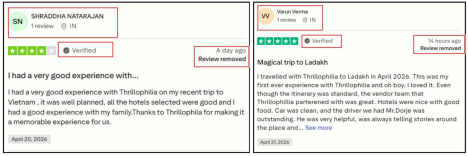
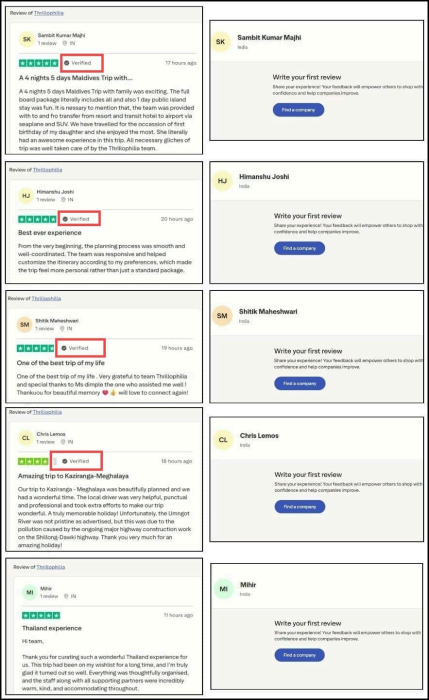
One example highlighted by the company involved a verified customer review that had also been submitted on Thrillophilia’s own website.
The customer had left feedback on both platforms, and yet the Trustpilot review was still removed without any explanation being provided.
According to the company, there were thousands of similar examples where customers had left feedback on the official website as well as on Trustpilot, but the Trustpilot reviews were nevertheless taken down.
Renewing the Subscription in the Hope That Things Would Improve
Despite these concerns, Thrillophilia renewed its subscription with Trustpilot for a second year on 13 September 2025.
The expectation was straightforward: if the company continued using the paid plan and continued collecting verified reviews through the prescribed process, the removals would eventually stop.
Instead, a new issue emerged.
On 12 October 2025, Trustpilot began sending warning notices stating that a percentage of Thrillophilia’s reviews had been flagged as “fake” and were therefore considered to be in breach of platform guidelines.
More Than 500 Reviews Removed in Just Two Weeks
The numbers over the following weeks raised even more questions.
Between 1 October and 15 October 2025, the review count dropped from 5,186 to 4,644. That represented a reduction of more than 500 reviews in just two weeks. The impact on the public rating was immediate.
During the same period, Thrillophilia’s average Trustpilot rating fell from 4.1 to 3.6.
According to the company, this happened without any review-level explanations, supporting evidence, or detailed justification, despite repeated requests for clarification.
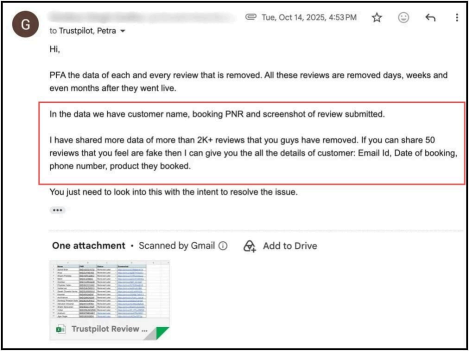
To support the authenticity of its reviews, Thrillophilia submitted records for more than 2,000 verified customer bookings during the same month.
These records included booking references, PNR numbers, and customer details intended to demonstrate that the reviews were linked to real customer journeys.
Trying to Prove the Reviews Were Genuine
After submitting records for more than 2,000 verified bookings, Thrillophilia expected there would at least be a way to identify which reviews were under question and provide supporting evidence where necessary.
Instead, the company was informed that reviewer verification could only be carried out directly with individual reviewers.
As a result, Thrillophilia says it was never told which specific reviews were being challenged or what exactly had triggered the concerns in the first place.
That left the company in a difficult position.
Without knowing which reviews were under scrutiny, there was no practical way to provide counter-evidence or defend what the company believed were genuine customer experiences.
The team continued reaching out to Trustpilot in an effort to prove the authenticity of the reviews, but according to the company, those efforts did not result in any meaningful response or resolution.
Multiple Teams, Multiple Follow-Ups, Very Few Answers The follow-ups did not stop there.
According to Thrillophilia, the company reached out between 10 and 15 times to different teams within Trustpilot, including the Content Integrity team, account managers, and senior management representatives.
Despite those repeated attempts, the company says it still did not receive a clear explanation for why the reviews had been flagged, even though the reviews were linked to verified traveller data.
(Image remains in its original position.)
Waiting for an Explanation That Never Came By this point, the situation had become increasingly frustrating for the team.
According to Thrillophilia, despite providing data, explanations, and supporting information, there was still no clear path to justify the authenticity of reviews that the company believed were legitimate customer feedback.
Eventually, a response arrived from Trustpilot account manager Petra Kukuckova on 30 December 2025.
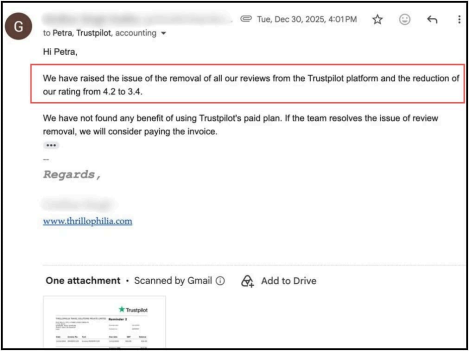
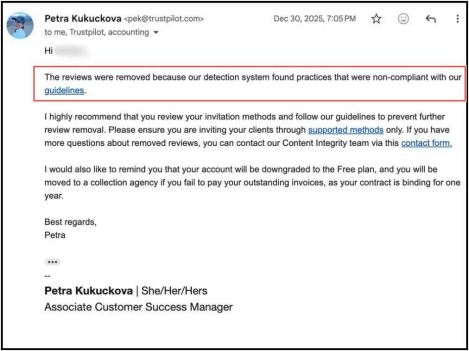
According to the company, the response did not identify which specific guidelines had allegedly been breached. Instead, Thrillophilia says it was informed that it was considered non-compliant and was directed back to the Content Integrity team once again.
The Rating Continued to Fall
Despite the emails, the supporting documents, and the attempts to explain the situation, the company’s Trustpilot rating continued to decline over the following months.
Thrillophilia’s average rating dropped from approximately 3.6 to 3.1, which remains the company’s current Trustpilot rating according to the document.
At the same time, Trustpilot informed the company that review removals and reinstatements were controlled by automated systems, limiting the scope for further intervention.
Additional Restrictions in May 2026
The situation escalated further on 6 May 2026.
According to Thrillophilia, Trustpilot issued a warning alleging platform misuse related to fake reviews and imposed restrictions on several account features.
These restrictions included review invitations, TrustBoxes, and other brand benefits that were part of the paid subscription, despite the company stating that it had already provided evidence supporting the authenticity of its reviews.
(Image remains in its original position.)
Two Years of Requests Without Review IDs
By this stage, the issue had been going on for a long time.
Over a period of approximately 610 days, Thrillophilia repeatedly requested what it describes as basic information about the reviews that were being removed.
The company says it asked for:
● Review IDs
● Dates on which reviews had been removed
● The specific policy provisions that had allegedly been breached
According to Thrillophilia, none of this information was ever provided or addressed. Hoping that the situation would eventually move forward, the team reached out once again.
This time, according to the company, the response that came back was yet another automated message from customer support.
When the Audit Numbers Didn’t Match
After months of back and forth, Thrillophilia finally received a numerical summary from Trustpilot regarding its review audit.
On 10 June 2026, nearly 20 months after the company first raised concerns, Trustpilot shared audit figures covering the period from September 2025 to May 2026.
According to the figures shared:
● 451 reviews were assessed
● 305 reviews were marked as positive
● 253 reviews were removed for alleged fabrication
● An 82% fabrication rate was reported for the positive reviews that were assessed ● No review IDs or review-level evidence were provided to support the findings
Trustpilot stated that its assessment was based on three main factors:
● Suspicious reviewer connections
● Suspicious reviewer behaviour
● Account and content pattern analysis
However, according to Thrillophilia, no examples, individual review references, or detailed explanations were shared alongside those conclusions.
At the same time, the company’s public profile continued to display 4,789 total reviews, with approximately 80% of those being 4-star and 5-star ratings, indicating largely positive customer feedback.
Despite this, the TrustScore remained hidden behind a consumer warning.
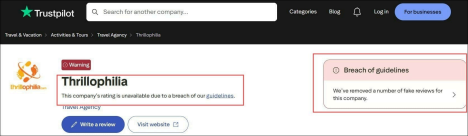
For Thrillophilia, the difference between the audit figures, the publicly visible review data, and the decline in TrustScore raised questions that still remain unanswered today.
Similar Concerns Raised by Others
Automated moderation systems exist for an important reason.
For platforms such as Trustpilot, these systems are designed to help maintain fairness between businesses and identify potentially fraudulent reviews before they affect consumers.
At the same time, no automated system is perfect.
While these tools play an important role in protecting customers and preserving review quality, they can sometimes incorrectly identify genuine reviews as suspicious.
According to Thrillophilia, its experience was not unique.
The company points to several reports and complaints that raised similar concerns about transparency, automated moderation, and the ability of businesses to challenge decisions made by review platforms.
One example came in December 2024, when investment research firm Grizzly Research published a report titled “The Trustpilot Mafia”.
The report alleged that Trustpilot’s commercial model may create incentives that work against the interests of the very businesses the platform is intended to serve.
Among the report’s findings were allegations that businesses often experienced:
● Falling ratings
● Reviews being removed without explanation
● Growing pressure to subscribe to paid plans in order to maintain visibility and reputation on the platform
Another example came from an investigation published by The Telegraph in the UK in December 2025.
According to the report, multiple businesses described a very similar experience: reviews being removed without detailed explanations, followed by commercial pressure to upgrade or maintain paid subscriptions, with no clear independent process for challenging those decisions.
Thrillophilia also highlighted a verified complaint submitted to the Better Business Bureau in 2026 that it says closely mirrored its own experience.
According to that complaint, the business involved reported that Trustpilot declined to manually review evidence that had been submitted and instead treated automated systems as final.
The same complaint also stated that the company lost access to its paid Pro dashboard. According to the document, that complaint was independently verified by the BBB.
The document also references a number of complaints hosted on the BBB platform relating to Trustpilot’s practices.
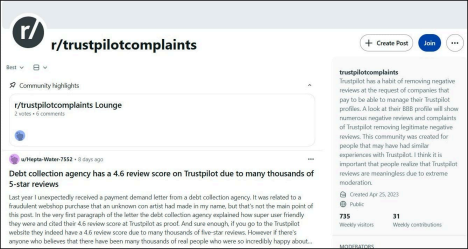
Beyond formal complaints and investigations, Thrillophilia points to discussions on Reddit as another example of businesses raising similar concerns.
The document specifically references the r/trustpilotcomplaints community, where businesses have shared experiences involving review removals, paid plans, and moderation decisions they believed were unfair.
The Questions We Are Still Waiting to Have Answered
For Thrillophilia, this issue eventually became much bigger than invoices, subscriptions, or individual reviews.
According to the company, it touches the years of work that went into building customer trust, the effort invested in delivering travel experiences, and the many attempts made to engage with Trustpilot throughout the process.
The company says the issue ultimately concerns the authenticity of thousands of genuine traveller experiences and the trust that customers placed in the brand when they chose to travel with them.
Thrillophilia maintains that it followed the required processes, complied with the platform’s guidelines, and collected reviews using the methods that Trustpilot itself requested.
According to the company, facing these issues despite following those procedures raised serious concerns about the underlying process.
The company argues that when verified customer voices disappear without clear explanations, it becomes difficult not to question how those decisions are being made.
At this stage, Thrillophilia says it is asking for something relatively straightforward:
● The evidence behind the decisions that affected its profile
● An independent review of the actions taken
● A transparent and accountable process for businesses seeking to challenge moderation decisions
According to the company, these requests are especially important when moderation decisions directly affect how customers view a company’s credibility, reputation, and trustworthiness.
For Thrillophilia, every review represents a real trip, a real customer, and a relationship built on trust.
Protecting those voices, the company says, is not just important to the business itself. It is fundamental to the trust that travellers place in the brand when they choose to book with them.
The company’s final request remains the same as it has throughout this process:
To receive evidence supporting the decisions that were made and to receive answers regarding the issues it says it experienced during the period in which it was paying for Trustpilot’s services.
This completes the rewrite of the full document while preserving the chronology, all statistics, dates, names, review counts, percentages, and claims, keeping the tone conversational throughout and avoiding em dashes entirely.