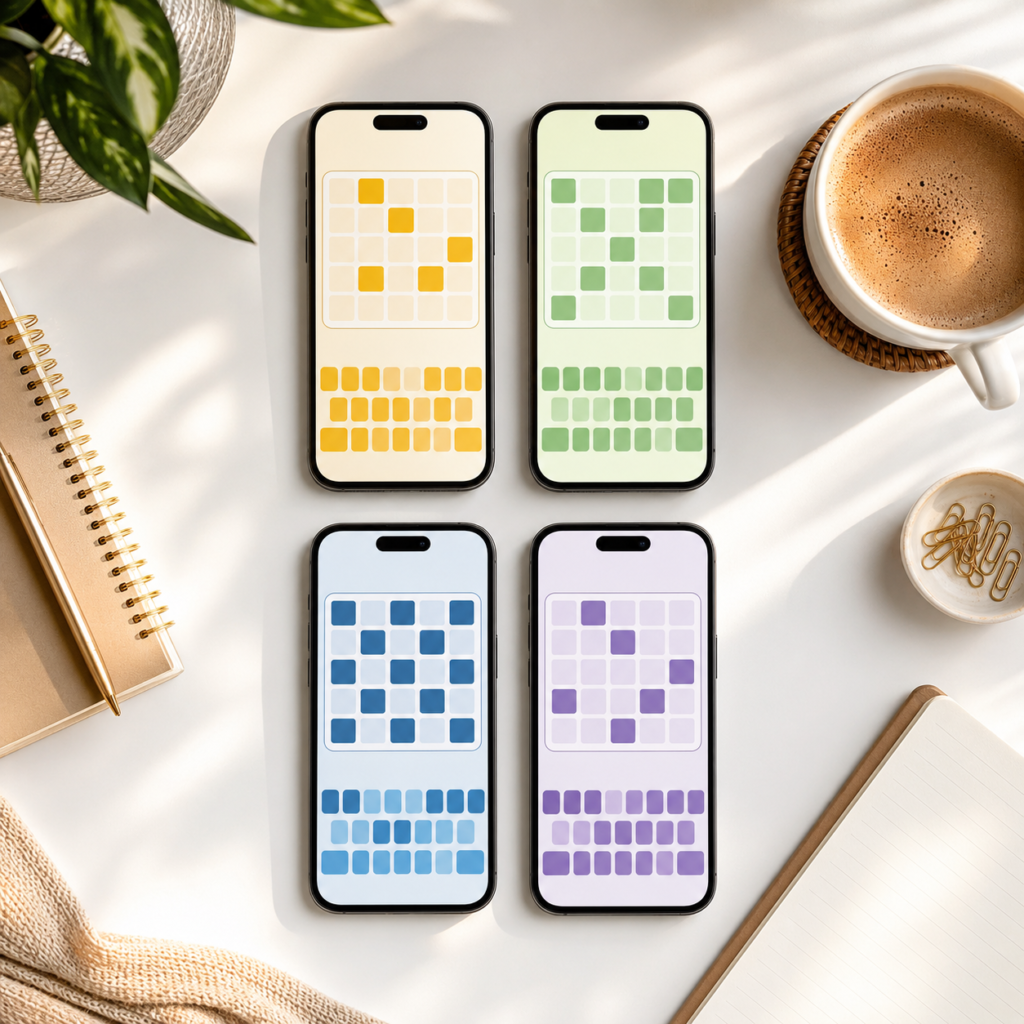
How the New York Times Became the Home of Daily Word Games
The New York Times did not set out to build a word game empire. It set out to keep readers engaged between news cycles. What happened instead was the quiet construction of the most played suite of daily word games in the world. Between Wordle, Connections, the Mini Crossword, Strands, and the Spelling Bee, the Times now has millions of players returning to its games section every single day, not for the news, but for the puzzles.
Each game in the collection solves a different problem. Wordle gives you one sharp challenge per day and gets out of the way in under five minutes. Connections asks you to think categorically, grouping words by hidden themes that only reveal themselves once you start making wrong guesses. The Mini Crossword offers the satisfaction of a crossword without the hour-long commitment. Strands is the newest addition, built around a hidden theme word called the spangram. And the Spelling Bee is the one that players consistently describe as the most addictive, the most humbling, and the hardest to quit.
Understanding what makes each game distinct helps you get more out of each one. It also helps you decide which games deserve a spot in your daily routine and which you can rotate in when you have extra time.
NYT Strands: The Newest Game in the Collection
Strands launched as an official NYT game in 2024 after a beta period, and it has quickly built a loyal following among players who found Wordle too quick and Connections too abstract. The game presents a grid of letters, and your job is to find themed words hidden within it.
Every Strands puzzle has a theme, announced at the top of the board. The words you find all relate to that theme, and they span the entire grid without overlapping. The special word in each puzzle is called the spangram, a portmanteau of spanning and pangram, because it stretches from one side of the grid to the other and contains the key to the theme itself.
Finding the spangram is the crowning moment of each Strands puzzle, equivalent to finding the pangram in the Spelling Bee or solving the final letter in Wordle. Players who find it without any hints feel a particular kind of satisfaction that the NYT puzzle team has become very good at engineering. The game is free to play for all readers, not just subscribers, which has helped it spread quickly through word-of-mouth in the same way Wordle did in 2021.
NYT Connections: Thinking in Categories
Connections presents sixteen words and asks you to sort them into four groups of four. The groups share a hidden connection, and the game color-codes them by difficulty from yellow through green, blue, and purple. The purple category is almost always a deliberate misdirection, using words that seem to belong somewhere obvious but actually share a more obscure link.
The design of Connections rewards lateral thinking over vocabulary. You do not need to know unusual words to solve it. You need to resist your first instinct, which is almost always partially wrong, and look for the connection that explains the most words at once. Players who approach it methodically, ruling out the most obvious group first and working toward the tricky ones, tend to finish without mistakes more often than players who guess intuitively.
Connections resets at midnight Eastern Time, the same as Wordle and the Spelling Bee. Many players treat the three games as a morning sequence, starting with Connections for the categorical challenge, moving to Wordle for the quick vocabulary hit, and finishing with the Spelling Bee for the deeper, longer engagement.
NYT Wordle: The Game That Started It All
Wordle was not created by the New York Times. Josh Wardle built it for his partner, shared it publicly in October 2021, and watched it go viral before selling it to the Times in January 2022. The acquisition cost, reported at over one million dollars, has since looked like one of the better media investments of the decade.
The rules are simple enough to explain in one sentence. Guess a five-letter word in six tries, and use the color-coded feedback after each guess to narrow down the answer. Green means the letter is correct and in the right position. Yellow means the letter is in the word but in the wrong position. Gray means the letter is not in the word at all.
What Wordle figured out that most word games had not was the value of scarcity. One puzzle per day, shared by everyone, creates a communal experience. You cannot binge Wordle. You play it once, and then you wait. That constraint, which might seem like a weakness, turned out to be the reason it spread so fast. Players shared their results on social media using the colored grid emoji format, and the game became a daily ritual for millions before most media companies had noticed it existed.
NYT Spelling Bee: The Most Addictive Game in the Collection
The Spelling Bee is the oldest of the current NYT word games, having launched in its digital form in 2014. It is also the one that generates the most passionate responses from players, both positive and frustrated.
The mechanics are deceptively simple. Seven letters appear in a honeycomb pattern. One letter sits at the center and must appear in every word you submit. Words must be at least four letters long, and letters can be reused as many times as needed within a single word. The goal is to find as many valid words as possible before midnight resets the puzzle.
What makes the Spelling Bee different from the other NYT games is its open-ended structure. There is no fixed number of guesses. There is no time limit. You can return to it throughout the day, adding words as they occur to you, checking your score against the ranking ladder that runs from Beginner through Good Start, Moving Up, Good, Solid, Nice, Great, Amazing, and Genius. Above Genius sits Queen Bee, which requires finding every single valid word in the puzzle and which most players reach only occasionally.
The scoring system rewards word length. Four-letter words earn one point each. Words of five or more letters earn one point per letter. The pangram, which uses all seven letters at least once, earns its letter score plus a seven-point bonus. Finding the pangram is the daily prize inside the puzzle, and experienced players often hunt for it first before filling in the shorter words.
How to Find the Spelling Bee Pangram Faster
The pangram is the centerpiece of every Spelling Bee puzzle, and finding it separates players who reach Genius from those who plateau at Amazing. Most players who struggle with the pangram are approaching it the wrong way.
The instinctive approach is to start with the center letter and build outward, testing familiar words and hoping the pangram emerges. This works for finding shorter words but is inefficient for pangrams specifically, because the center letter is common by design and does not narrow the search much.
The more effective approach starts with the rarest letter in the hive. If the puzzle includes a V, K, W, Q, or Z, the pangram almost always contains that letter as a structural anchor. Thinking about words that require that rare letter, then checking whether the other six letters can fill in the rest, produces results faster than working from the center outward.
Suffix hunting is the second major technique. Systematically pairing suffixes like ING, TION, NESS, LY, and MENT with the center letter, then checking whether the remaining hive letters can support them, unlocks clusters of longer words including pangram candidates. Players who use this method consistently find the pangram within ten minutes on most days.
For days when the pangram stays out of reach despite both methods, checking a dedicated resource for the daily puzzle gives you just the pangram without revealing the full word list. Looking up the nyt pangram answer today from a reliable source lets you confirm or discover that single word and continue working through the rest of the puzzle independently, preserving the challenge while removing the specific blockage that was stopping your progress.
Strategies Across All Four Games
Each NYT game rewards a different cognitive skill, and players who play all four regularly tend to notice cross-game benefits over time.
Wordle builds deductive reasoning. The process of eliminating letters systematically and updating your mental model after each guess is a form of structured logic that carries into how you approach other problems. Players who develop strong Wordle strategies, using opening words that cover common letters and updating their guesses based on all available information, tend to apply the same systematic thinking to other puzzles.
Connections builds resistance to misdirection. The game is specifically designed to make you wrong about your first instinct. Players who get better at Connections learn to slow down before committing to a group and to ask themselves what alternative connection might explain the same words. This habit of questioning obvious interpretations is useful well beyond word games.
Strands builds thematic thinking. Finding words that fit a hidden theme requires holding the theme in mind while scanning the grid, a form of constrained creativity that is different from the open vocabulary recall the Spelling Bee demands.
The Spelling Bee itself builds vocabulary and pattern recognition simultaneously. Players who play daily for several months consistently report that they start noticing letter combinations in everyday reading that they would have overlooked before. The game trains your brain to see words inside other words, which is a genuine perceptual shift that extends into reading and writing.
Making the Most of the Daily NYT Game Routine
The players who get the most out of the NYT word game suite treat it as a sequence rather than a collection. Starting with Connections sets a categorical thinking mode. Moving to Wordle shifts you into deductive mode. The Spelling Bee, which can be returned to throughout the day, works best as the background puzzle, the one you leave open and add words to between tasks.
Getting the full daily spelling bee answers at the end of the day, after you have played to your natural stopping point, is a different experience from looking them up immediately. Seeing what you missed teaches you specific words and letter patterns that you are more likely to remember because you already spent time searching for them. The words that appear on the answer list after a long session feel like discoveries rather than revelations, which makes them stick.
Strands answers, available at strandsanswers.com, serve the same function for that game. Checking what the spangram was after you have attempted the puzzle, rather than before, turns the reveal into a learning moment rather than a shortcut.
The NYT has built something unusual in the games section, a collection of daily puzzles that are each genuinely good at what they do, that complement rather than compete with each other, and that reward consistent play over time. Playing all four daily takes between fifteen and forty-five minutes depending on how deep you go with the Spelling Bee. Most players who build that routine report that it is one of the more durable habits they have developed, precisely because the games reset every day and the challenge never gets stale.


