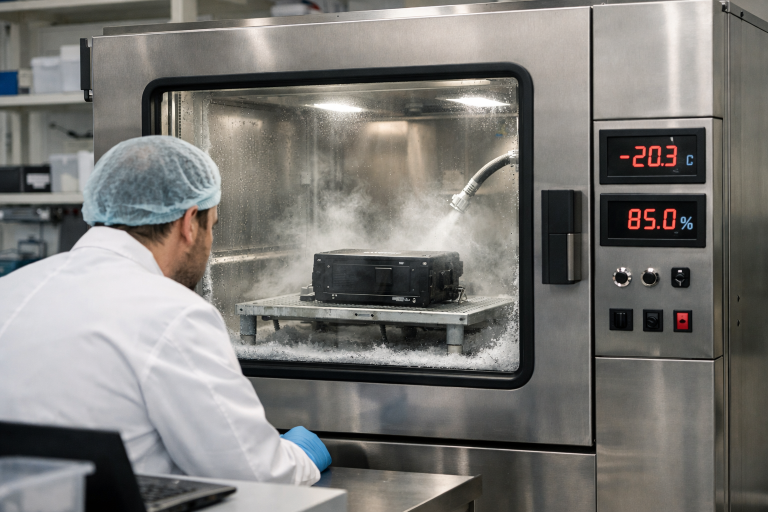
Environmental test chambers are indispensable for businesses and research labs seeking to ensure the reliability, safety, and compliance of their products. These chambers replicate real-world environmental scenarios, testing how materials and electronics perform under varying conditions. For example, a thermal chamber can simulate temperature extremes to assess a product’s durability and function, which is especially crucial in industries where failure is not an option.
By offering controlled and repeatable environments such as extreme heat, cold, humidity, pressure, and vibration, environmental test chambers save time and reduce costs by allowing pre-launch evaluations. This improves product quality and consumer safety, making them an essential investment for manufacturers, engineers, and scientists.
What Are Environmental Test Chambers?
Environmental test chambers are sophisticated enclosures engineered to precisely control environmental variables during product testing. These variables can include temperature, humidity, atmospheric pressure, and even simulated vibrations. By exposing products to anticipated environmental stressors, these chambers provide invaluable data that guides design improvements and validates product claims before commercial distribution.
Many sectors use these chambers for compliance, quality assurance, and new product development. For instance, electronics manufacturers rely on test chambers to certify that components will function correctly, whether they are installed in arctic or tropical environments.
The modern design of environmental test chambers continually evolves to address emerging industry requirements. Many chambers are now equipped with digital displays and programmable controllers that allow users to set up complex test cycles with multiple variables simultaneously. This increased sophistication enhances the ability of research teams to fine-tune product designs for global market requirements. Additionally, chambers can be customized with specialized components such as gas injection systems or ultraviolet light sources to accurately reproduce niche operating conditions.
Types of Environmental Test Chambers
Test chambers come in many forms, each tailored to simulate specific conditions or sets of conditions. Here are some common types:
- Temperature Chambers: These chambers allow users to test products at extremely high or low temperatures as well as rapid thermal cycling.
- Humidity Chambers: Capable of controlling relative humidity, these chambers are ideal for testing material endurance against condensation or dampness.
- Altitude Chambers: Used to mimic high-altitude, low-pressure environments, these are vital for aerospace and defense applications.
- Vibration Chambers: These simulate physical shocks and shakes, crucial for testing automotive or aerospace components.
In addition to the most common chamber types mentioned above, specialized models such as salt spray chambers and corrosion test chambers are used to test resistance to corrosion in marine or industrial environments. Such chambers expedite weathering and aging simulations, supplying valuable insight into long-term reliability and helping to facilitate product warranties and guarantees.
Applications in Various Industries
The value of environmental test chambers spans multiple industries:
- Aerospace: Aircraft components must withstand varying altitudes, pressures, and temperatures, so rigorous testing is a must.
- Automotive: Vehicle parts endure everything from desert heat to frigid winters. Test chambers ensure reliability and safety.
- Electronics: Devices must endure moisture, heat, and cold, especially as they become more pervasive in everyday life.
- Pharmaceuticals: Climate-controlled chambers confirm drug stability and effectiveness under different environmental conditions.
Beyond these industries, environmental test chambers are also vital in sectors such as defense, telecommunications, and renewable energy. To learn more about the wide-ranging impacts of reliable testing, see the in-depth coverage from Scientific American.
Research institutions also use these chambers to explore the effects of climate change on biological samples or civil engineering materials. For example, simulating prolonged drought, flooding, or freeze-thaw cycles helps scientists predict the real-world durability of products, buildings, and infrastructure. Environmental chambers often operate alongside advanced data-logging systems, making it easy to share results, compare materials, and collaborate on global research projects.
Recent Advancements in Test Chamber Technology
As industries become more demanding and regulations more stringent, advances in test chamber technology have followed suit. One standout development is the introduction of extended-range thermal chambers, enabling precise temperature control across broader ranges. For example, Federal Electronics recently introduced a chamber that operates from -70 degrees Celsius to +200 degrees Celsius, making third-party lab rentals unnecessary and streamlining R&D timelines.
Another important innovation is the blowing sand chamber developed by the National Institute for Aviation Research (NIAR). These chambers reproduce desert-like conditions with fine sand and dust to see how sensitive equipment, such as avionics, fares under abrasive, particulate-laden environments.
Test chamber advancements often include updated user interfaces, remote diagnostics, and self-calibration routines, which further reduce downtime and manual intervention. Enhanced safety features, such as automatic shut-off mechanisms or redundant sensor arrays, also contribute to confident, efficient testing operations.
Key Considerations for Selecting a Test Chamber
- Testing Requirements: Pinpoint the conditions your tests must replicate, such as temperature extremes, humidity range, or specific vibration frequencies.
- Chamber Size: Make sure your chamber’s interior can accommodate the size and quantity of specimens you plan to test, allowing for airflow and sensor placement.
- Performance Specifications: Assess whether the chamber can meet precise requirements with stability and uniformity throughout the test.
- Compliance Standards: Verify that the chamber conforms to regulatory and industry norms, such as those set by ISO or ASTM.
Energy consumption, overall maintenance requirements, and available technical support are additional considerations worthy of evaluation. Companies should request detailed documentation from manufacturers so that end-users can anticipate the long-term costs and operational needs associated with their chosen chamber. Additionally, if scalability is important, modular systems allow organizations to adapt to expanded or shifting workloads withou t investing in entirely new equipment fleets.
Future Trends in Environmental Testing
Environmental testing is evolving rapidly in response to modern manufacturing and sustainability challenges. One trend is the development of modular and portable test chambers, which allow teams to move equipment into the field or operate in smaller lab spaces. Compact chambers are driving R&D efficiency, especially for startups and academic labs seeking agility.
Integration with the Internet of Things (IoT) is another pivotal change, enabling real-time monitoring, cloud-based data analysis, and predictive maintenance. Connected sensors provide granular insights and enable remote operation, supporting both efficiency and traceability.
Furthermore, as global energy consumption becomes a primary concern, next-generation environmental test chambers are focused on energy efficiency. Manufacturers are utilizing improved insulation, energy-recovery systems, and eco-friendly refrigerants to minimize their carbon footprint.
Another emerging trend in environmental testing is the integration of artificial intelligence (AI) and machine learning algorithms to analyze complex datasets generated during testing cycles. These tools can help organizations quickly identify performance anomalies, anticipate possible failure points, and optimize testing protocols for greater accuracy and efficiency. Collaborations between test equipment manufacturers and research universities are accelerating the adoption of these advanced analytics, paving the way for even smarter and more responsive testing environments in the near future.
Conclusion
Environmental test chambers are crucial to modern research, quality assurance, and product design. They ensure products meet safety, reliability, and regulatory demands before hitting the market. As technology evolves, staying updated on innovations in chamber capabilities, operational efficiency, and sustainability is key to maintaining a competitive edge and delivering exceptional products to market.
In summary, the future of environmental testing points to even more integration, connectivity, and automation. As global standards continue to rise, leveraging new features and expanding test chamber capabilities will help organizations drive innovation, demonstrate compliance, and uphold quality standards across rapidly changing industries.