Type a quick search for storage units near me, and you’ll get a wall of results that all promise the same things: clean units, great security, friendly staff. So how do you tell them apart before you’ve already signed a lease and loaded a truck?
The honest answer is that the differences between facilities are real, but almost none of them show up in a listing. They show up on your commute, in the hallways, in the thermostat settings, and in the fine print. This guide walks through what actually separates a good storage facility from a frustrating one, and how to verify each difference yourself.
Why All Storage Units Near Me Look Identical Online
Every facility photographs its newest corridor under its brightest lights. Every listing mentions security and cleanliness. That’s not deception so much as marketing doing what marketing does.
The real differences are operational
What varies between facilities is how they run day to day: who maintains the locks, how often pests are treated, whether the cameras actually record. None of that fits in a search snippet. It only becomes visible when you know what to look for, which is exactly what the rest of this guide covers.
Distance is the first filter, but not how you think
Kilometers on a map matter less than minutes on your actual route. A facility ten minutes along your daily commute gets visited and stays organized. One that requires a dedicated detour tends to become an expensive box of forgotten things.
Before comparing anything else, ask a simple question: is this place on a road I already drive?
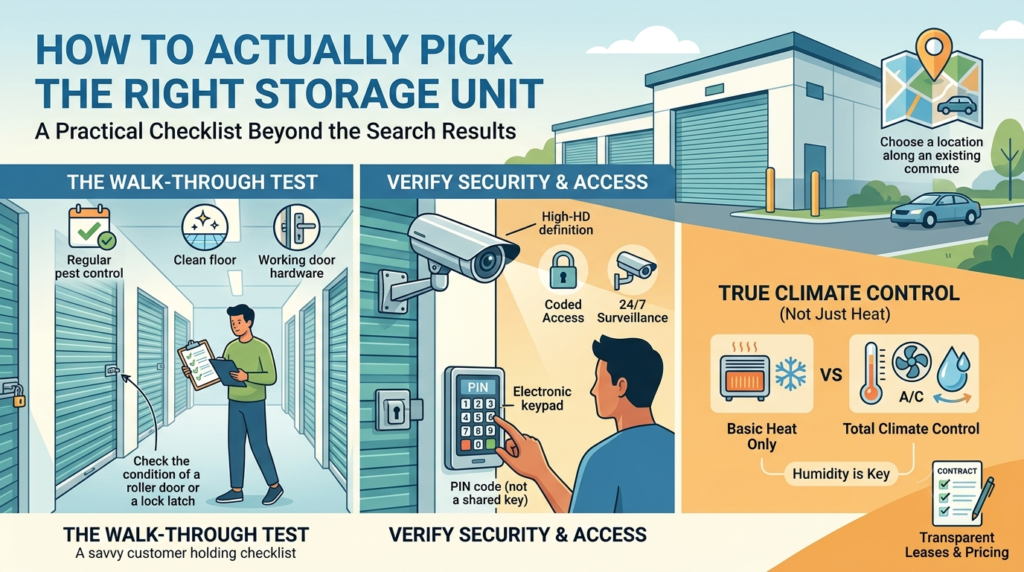
The Walk-Through Test
If you learn how to choose a self storage facility from one section of this article, make it this one. Book a visit, and treat it as an inspection rather than a tour.
Security you can verify on the spot
Don’t settle for the word “secure.” Check whether cameras cover the corridors and access points, not just the front desk, and ask what kind of access control is used, since an individual PIN code is far more traceable than a shared key.
You can see how one operator documents this by reviewing the security features at Pandora Self-Storage, which lists HD camera surveillance and coded access rather than vague promises.
Cleanliness is a management signal
A tidy facility isn’t about aesthetics. It tells you the same team that sweeps the hallway is also the team maintaining your unit’s door seal. During your visit, check for:
A recently vacated unit — Ask to see one instead of the display unit. Its smell and floor condition reveal the true maintenance standard.
Working hardware — Test a few unit doors and latches in the corridor. Sticky or damaged mechanisms point to deferred maintenance everywhere else.
Pest control on a schedule — Ask directly how often treatments happen. A confident, specific answer matters as much as the treatment itself.
Climate Control Is a Spectrum, Not a Checkbox
Here’s the industry’s best-kept non-secret: “heated” and climate controlled storage are not the same product. A heated unit may simply be kept above freezing, sometimes as low as 41 degrees Fahrenheit, with no humidity management at all.
In a place like Quebec, where winters are brutal and summers are muggy, that gap matters. Wood furniture swells and cracks with humidity swings, leather turns brittle in dry cold, and electronics dislike both extremes. True climate control means three systems working together:
✅ Heating — Keeps winter temperatures stable rather than merely survivable. Stability, not just warmth, is what protects your belongings.
✅ Air conditioning — Prevents summer heat from baking your belongings for months. Sealed rooms without cooling can run far hotter than the outdoors.
✅ Humidity control — The piece most often missing, and the one that actually protects wood, fabric, and documents. Ask for it by name.
When you visit, ask one precise question: “What humidity level do you maintain?” A facility with real climate control will have an answer. A facility with a furnace will change the subject.
The Lease Tells You Who You’re Dealing With
The contract is where good facilities and mediocre ones quietly part ways. Read it before you’re standing at the counter with a loaded van.
What flexible actually means
A month-to-month storage rental should mean you can leave with roughly thirty days’ notice and no exit penalty. Some leases advertised as monthly still bury early-termination fees or automatic renewals with strict notice windows, so read those clauses first.
The quoted price is rarely the full price
Ask what the monthly rate excludes. Administration fees, mandatory locks, after-hours access charges, and required insurance can all sit outside the advertised number. Comparing facilities only works when you compare the all-in cost, taxes included.
The Ten-Minute Visit That Saves You Months of Regret
Searching for storage units near me is the easy part; choosing well takes one visit and a handful of pointed questions. Check the route, walk the corridors, ask about humidity, and read the lease like it matters, because it does.
If you’re in Montreal’s West Island, you can put this checklist to work at these storage locations in Kirkland and Pointe-Claire, where the answers to every question above are posted rather than promised.
What’s the one thing you wish you’d checked before renting your last storage unit?