A pharmacy fails a state board audit. The product traces back through three handoffs, and no one can produce a clean chain-of-custody record. The owner assumed their supplier’s license covered them. It didn’t really. This scenario plays out more often than most buyers realize, and it kind of begins with this question that the industry, rarely answers quite right: what is it that truly separates pharmaceutical distributors from wholesalers, and also who carries the legal responsibility when something goes wrong.
Most content treats this as a vocabulary problem. It isn’t. The real issue is accountability, like who’s actually owning it. These suppliers and wholesalers sit at different points in the supply chain, and that spot kinda decides who documents what, who checks the licenses, and who has to answer regulators when a shipment, can’t be traced. Buyers who skip this distinction don’t just risk paying more. They risk exposure they didn’t know existed.
The Question Everyone Gets Wrong: “What’s the Difference” Isn’t the Real Risk
Most buyers assume the distinction between pharma distributors and wholesalers comes down to price or delivery speed. It doesn’t. The distinction that matters is regulatory accountability.
The Drug Supply Chain Security Act , also known as DSCSA, lays out how prescription drugs make their way through the U.S. supply chain. Most pharmacy owners never actually read it closely enough , but still, they’re stuck with its rules.
A common misconception derails buyers early: “If my supplier holds a valid license, I’m automatically protected.” Federal guidance places responsibility on the receiving party too. Verification and traceability duties don’t stop at the supplier’s door.
The stakes are concrete, not theoretical:
- Counterfeit or diverted product entering your inventory undetected
- Audit failures tied to missing or incomplete documentation
- State board penalties for insufficient license verification
Understanding this shifts the conversation from convenience to risk management.
Where the Liability Actually Sits in the Supply Chain
Documentation obligations differ sharply depending on where a supplier sits in the chain.
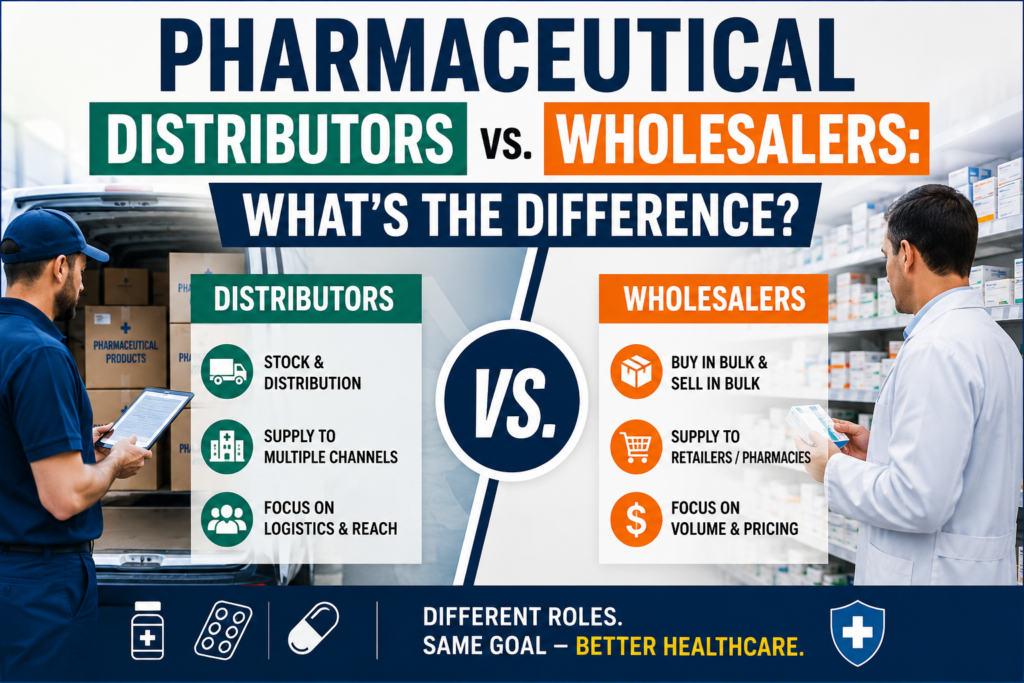
Pharmaceutical distributors typically generate Transaction History, Transaction Information, and Transaction Statement records (collectively, “T3”) directly from their manufacturer relationships. That direct line creates a shorter, more traceable documentation path.
Wholesalers operate differently. Because they buy from distributors rather than manufacturers, an additional link enters the chain. Every added handoff introduces:
- More parties responsible for accurate recordkeeping
- More opportunities for documentation gaps
- Greater difficulty reconstructing a clean trail during an audit
A persistent misconception treats extra intermediaries as simply “added cost.” That framing misses the real issue: more intermediaries mean more traceability risk, not just more markup.
State boards evaluating audit failures consistently point to the same root cause. Buyers couldn’t produce verification records because no one in the chain owned that responsibility clearly.
Who Verifies What — A Responsibility Breakdown
Responsibility flows through four stages: manufacturer, distributor, wholesaler, pharmacy.
A critical point buyers overlook: the receiving pharmacy isn’t automatically cleared of fault, even when a supplier upstream made the error. The FDA explicitly urges buyers to independently validate wholesale distributor licenses rather than assume compliance.
The Counterfeit Product Blind Spot Most Buyers Ignore
Counterfeit and diverted drugs are more likely to infiltrate the supply chain at the wholesaler level, where sourcing tends to be more fragmented.
Context matters here. The three largest national suppliers in this space — McKesson, Cardinal Health, and AmerisourceBergen — control roughly 90% of U.S. pharmaceutical distribution. That consolidation creates tighter oversight and more consistent compliance infrastructure. Regional and independent wholesaler networks, by contrast, often lack that same scale of internal verification systems.
A dangerous misconception persists: “a good price signals a legitimate product.” It doesn’t. Buyers should treat certain signals as red flags:
- Pricing significantly below market average with no clear explanation
- Reluctance to provide complete T3 documentation
- Inconsistent or partial chain-of-custody records
A compliant trail shows an unbroken, verifiable line from manufacturer to your shelf. A suspicious one shows gaps, delays, or missing paperwork exactly where verification should be strongest.
How to Vet a Distribution Partner Before Liability Becomes Your Problem
Vetting a supplier is risk prevention, not procurement paperwork. Before signing with any distribution partner or wholesaler, confirm the following:
- License validation: Request current state and federal licensing documentation directly. Don’t rely on verbal assurance.
- T3 documentation on demand: A compliant partner produces this without delay or resistance.
- State board registration checks: Confirm active, unexpired registration in every state where product ships.
- Audit history transparency: Ask whether the supplier has faced prior compliance actions.
A common misconception treats supplier reputation as sufficient due diligence. Reputation doesn’t produce a paper trail. Documentation does.
Questions to Ask Before Signing With Any Supplier
- Can you provide complete T3 documentation for every shipment?
- What proof of licensing can you share before we finalize terms?
- How do you handle chain-of-custody records during an audit?
- Have you faced any state board compliance actions in the past three years?
Why Drugzone’s Model Closes the Compliance Gap
Drugzone works straight with manufacturers, which kinda keeps the paperwork short, more traceable, and audit-ready. It’s that setup, more or less, that solves the very liability gap described earlier: less back and forth, cleaner accountability , and checks built into each transaction instead of being assumed later on.
Conclusion: Compliance Isn’t Optional, It’s the Foundation
The space between pharma distributors and wholesalers isnt really theoretical. It ends up deciding who’s on the hook when paperwork goes sideways, when fake goods manage to slip in, or when a state board audit uncovers a messy chain of custody. Drugzone Pharmaceutical Inc. built their whole approach around narrowing that gap—like, direct ties with manufacturers, clear T3 paperwork, and checks that keep purchasers protected before any headaches show up later. For pharmacies, clinics, and healthcare facilities that can’t afford regulatory exposure, that structure isn’t a convenience. It’s the standard every sourcing decision should be measured against.
FAQs
- If my wholesaler makes a documentation error, am I still liable during a state board audit?
Yes. Regulatory guidance places verification responsibility on the receiving pharmacy as well as the supplier. An upstream error doesn’t automatically clear your facility of fault if you can’t produce your own compliance records.
- How can I tell if a distributor’s chain-of-custody documentation is actually compliant?
A compliant partner just hands over the complete Transaction History, the Transaction Information and also the Transaction Statement (T3) records, with no delay, no resistance. If there are gaps, partial paperwork, or some hesitation when it comes to sharing documentation, those are red flags really worth looking into first, before signing.
- Does buying from a wholesaler always mean higher counterfeit risk than buying from a distributor?
Not always, but these fragmented wholesaler networks seem to carry more risk because there are extra handoffs and, honestly the oversight is less standardized, like it slips around in the process a bit. Consolidated national suppliers tend to maintain tighter verification systems, which is why sourcing history and documentation practices matter more than price alone.