A few years ago, customers were willing to work around a business’s schedule. In today’s world, businesses are expected to work around the customer’s schedule.
While it might seem minor, the change has completely altered how organizations book appointments.
From a hospital that must process hundreds of patient visits, to a bank where they need to conduct advisory meetings, to a government office providing for citizens, the initial contact occurs before someone steps through the door. It occurs when someone attempts to schedule an appointment.
And that experience matters more than many organizations realize.
A customer who takes 3 minutes to book an appointment online comes with confidence. A customer who takes thirty minutes to get to the right department is likely to arrive frustrated before the service has even started. Many times, the disparity between those two experiences is just one thing—appointment management.
In the following blog, we’ll explore how implementing an online appointment booking system can help businesses manage and simplify their appointment scheduling for better customer service.
The Real Cost of Poor Scheduling
Most businesses are not businesses that wake up one day and decide to have long waits.
It typically occurs over time. There are a few additional calls each day. Staff starts to manage several calendars. Appointments are scheduled by email, phone, WhatsApp, or in person. What was once easy to handle gradually becomes hard to control.
Soon, the symptoms begin to show.
Customers come in at the same time because they have so many appointments in one window. Employees spend more time coordinating schedules than helping customers. Reception desks become crowded. Waiting rooms fill up.
Management often sees the queue. What they don’t always see is the revenue being lost behind it.
Every missed call could be a missed customer. Every delayed appointment can affect satisfaction. Every no-show creates unused capacity that can never be recovered.
Scheduling may seem like an administrative task, but its impact reaches far beyond administration.
Why Customers Have Changed Their Expectations
Think about how people book almost everything today.
- Flights are booked online.
- Hotel reservations happen online.
- Food deliveries happen online.
- Even healthcare consultations can be arranged online in many parts of the world.
As consumers’ expectations shift to instant access in other areas of life, patience for outdated scheduling processes naturally declines.
Customers no longer compare your booking experience only to your competitors.
They compare it with every convenient digital experience they have elsewhere.
That’s why businesses that simplify scheduling often see improvements that extend beyond operational efficiency. They are meeting customers where expectations already are.
The Connection Between Scheduling and Wait Times
Many organizations treat appointment booking and wait time management as separate challenges. In reality, they are closely connected.
Long wait times often begin long before a customer arrives.
When appointment slots are manually managed, it becomes difficult to predict demand accurately. Certain periods become overloaded while others remain underutilized.
An online appointment booking system creates structure.
Instead of reacting to customer traffic, businesses gain the ability to distribute demand more evenly throughout the day.
The outcome is surprisingly simple.
Customers spend less time waiting.
Employees experience fewer disruptions.
Managers gain greater visibility into operations.
Everyone benefits from a more predictable environment.
Why Businesses Are Moving Beyond Basic Calendars
The conversation around appointment booking has evolved.
Organizations are no longer looking for a digital replacement for a paper calendar.
They are looking for ways to improve the entire customer journey.
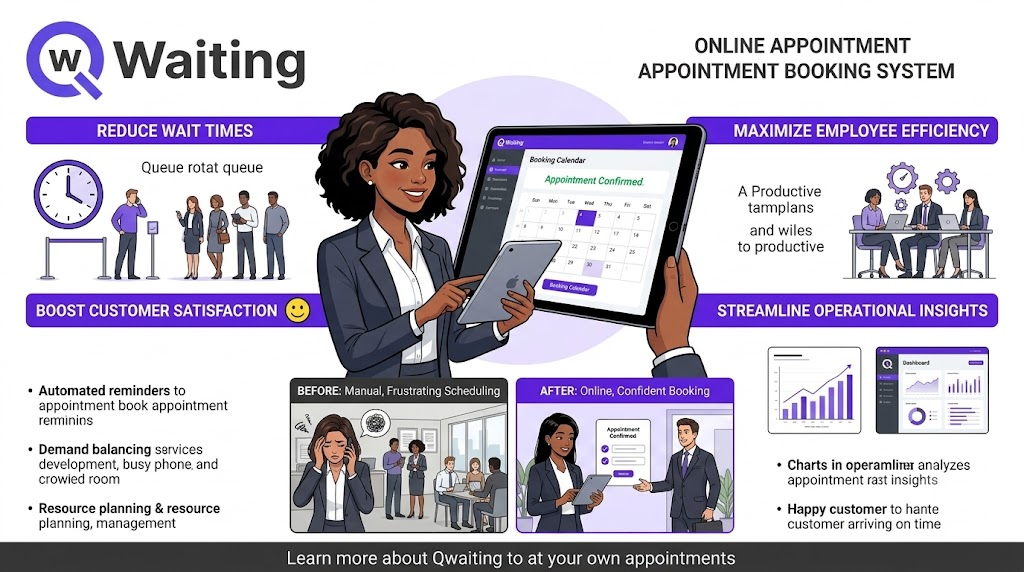
Smart queue management systems now help businesses:
- Reduce no-shows through automated reminders
- Balance customer demand across locations and teams
- Give customers self-service options
- Collect operational insights through analytics
- Improve resource planning
What makes these capabilities valuable is not the technology itself. It’s the business outcomes they create.
- Shorter queues.
- More productive employees.
- Better customer experiences.
- Higher service capacity.
Those are metrics leadership teams care about.
The Industries Seeing the Biggest Results
Healthcare organizations have been among the earliest adopters of online appointment booking because patient wait times directly influence satisfaction.
Banks followed for a similar reason. Customers are more likely to schedule an appointment to receive financial advice or services than to stand in line at a branch.
Government agencies are also adopting an appointment-only approach to service models to streamline the citizen experience and better control demand.
Even retail stores are discovering the benefit of appointments, especially for consultations, high-end services, and tailored shopping.
While the industries differ, they have one thing in common: the need to manage people efficiently without negatively impacting service quality.
Looking Ahead
The future of appointment management isn’t really about appointments.
It’s about time.
Customers want more control over theirs.
Businesses want to use theirs more efficiently.
Online appointment booking systems help achieve both goals.
The organizations that recognize this are no longer treating scheduling as an operational necessity. They see it as part of the customer experience strategy.
And as expectations continue to rise, that perspective will become increasingly important.
After all, customers rarely remember the software a business uses.
They remember whether the experience felt easy.
And in many cases, that experience begins with booking an appointment.