My cousin still plays a strategy game from 2011 most weekends, on a laptop that struggles to run a browser with more than six tabs open. The game looks exactly like what it is: a decade old. Nobody in that community has mentioned the graphics in years. What they talk about, constantly, is a build order someone discovered last month.
That’s the thing the industry spent a long stretch not quite admitting. For a good chunk of gaming history, progress got measured in numbers that were easy to put on a box: more polygons, higher resolution, bigger maps. Every new console generation arrived with the same pitch: that this time the visuals would change everything, and for a while the pitch mostly held up.
Then something didn’t quite fit. The games people kept coming back to, years later, weren’t always the ones that had pushed rendering technology the hardest. They were the ones with decisions worth making, progression that felt earned, and communities that stuck around long after the trailer’s lighting effects stopped mattering to anyone.
I don’t think that’s a coincidence, and the industry is slowly catching up to what players already knew.
Trailers Sell the Dream. Sessions Sell the Truth.
A striking trailer still does exactly what it’s supposed to do. Cinematic lighting and a dramatic score can sell a game in ninety seconds, and marketing budgets reflect that reality for good reason.
Actually playing the thing is a separate experience entirely. Somewhere around the one-hour mark, most players stop noticing texture resolution. Attention shifts toward pacing, toward whether the controls respond the way you expect, toward whether getting better at the game actually feels like getting better.
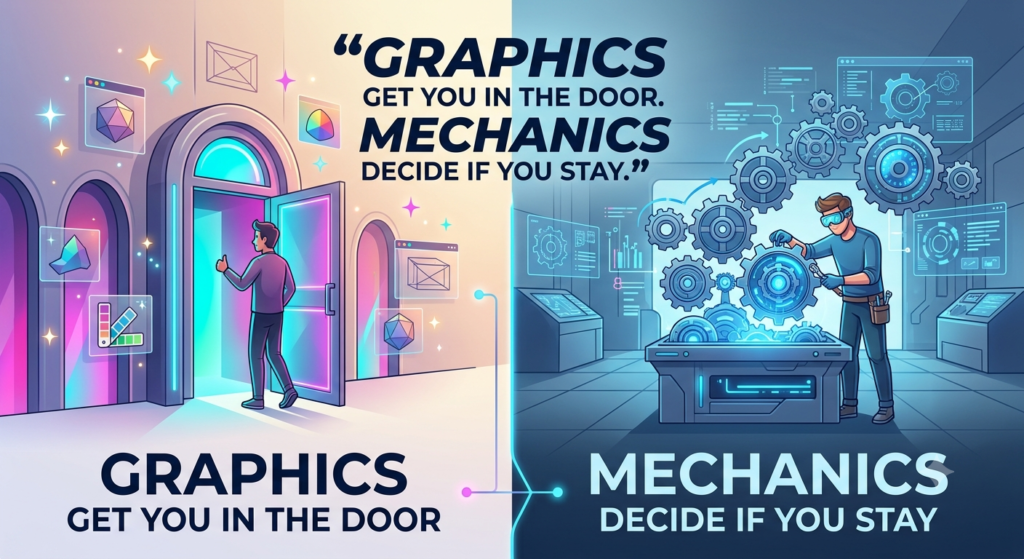
Graphics get someone to press install. Mechanics decide whether they’re still playing in March.
The Technical Gap Between Studios Basically Closed
Modern engines changed the competitive landscape in a way that doesn’t get discussed enough outside developer circles. A three-person studio can now produce lighting and animation that would have required a hundred-person team fifteen years ago.
Big-budget productions still push technical boundaries in ways smaller teams can’t match; that part hasn’t changed. But the baseline visual quality across the industry has risen so much that graphics alone rarely separate a hit from a flop anymore.
When everyone can hit a reasonably high visual bar, the differentiation has to come from somewhere else. Balance, interaction design, and the feel of moment-to-moment decisions carry more competitive weight than they used to, mostly because the old advantage stopped being scarce.
Decisions Are What Actually Stick With You
Ask someone about a game they loved years ago and watch what they describe. It’s rarely the environment art.
It’s usually a specific moment: a risky call that paid off, a build they figured out through trial and error, a comeback that felt entirely earned because the systems allowed for it. That kind of memory sticks because the player made it happen. Nobody scripted the outcome for them.
Games built around choices with real weight tend to create their own gravity. Mastery becomes the goal, not completion, and that shift changes how people talk about a title long after launch.
Old Games Don’t Age the Way People Expect
Technology gets outdated fast. What looked cutting-edge five years ago now looks a little embarrassing, and that’s just how hardware cycles work.
Good mechanics follow a completely different clock. A tightly balanced ruleset, a clear objective, controls that respond the way your hands expect- these things don’t really depend on what year it is. They depend on how people think, and human psychology doesn’t get a hardware refresh every eighteen months.
That’s the real explanation for why some genuinely old games still have active, opinionated communities despite looking dated by any modern standard. The visuals stopped being the draw a long time ago.
Communities Talk About Systems, Not Shaders
Check any forum or Discord server built around a game that’s been out for more than a year. The conversation has usually moved past graphics entirely.
People argue about matchup theory. They post clips of a specific interaction that worked better than expected. They recommend approaches to newcomers and argue, sometimes heatedly, about which strategy actually holds up under pressure.
Games that reward experimentation generate this kind of conversation naturally, because every player is running slightly different experiments. A handful of things communities tend to rally around:
- Discovering an unintended but useful interaction between two systems.
- Debating whether a recent balance patch actually fixed the problem it targeted.
- Comparing approaches to the same challenge and arguing about which one scales better.
Shared problem-solving builds a stronger bond than shared appreciation for a lighting engine ever could.
Competitive Scenes Made the Pattern Obvious
Competitive gaming forced this distinction into the open faster than casual play did. Watch any serious tournament and the commentary rarely mentions the art direction.
It’s about execution under pressure, reading an opponent, a decision made in half a second that either pays off or doesn’t. Those moments hold up regardless of how the game looks, because they’re demonstrating something human, not something rendered.
That’s part of why competitive titles with genuinely dated visuals still pull large audiences. Viewers aren’t there for the scenery.
Accessibility Changed Who’s Even Playing
Browsers, mobile hardware, and cloud infrastructure have all improved to the point where developers can reach people who never owned a dedicated gaming setup. That’s not a small shift. It’s arguably the biggest audience expansion the industry has seen in years.
More people now encounter interactive entertainment on devices they already carry around, rather than hardware they had to specifically buy for the purpose. And as that audience broadens, design has followed. A growing share of the market now consists of skill-based gaming experiences that prioritize responsive controls and clear mechanics over technical showmanship, precisely because that’s what wins over players who didn’t come from a traditional gaming background.
Accessibility, in this context, isn’t really about graphics scaling down to run on weaker hardware. It’s about design that welcomes someone in without demanding they already know the genre’s conventions.
Studios Started Building Like Product Teams
Plenty of development studios have quietly shifted how they operate. Retention now matters more than launch-week headlines, and that changes what gets prioritized internally.
A gorgeous launch trailer still generates buzz. Keeping people around for six months requires something sturdier, which is why studios have leaned harder into player feedback loops, usability testing, and iterative balance changes long after release rather than treating launch as the finish line.
I’d call this closer to product design than traditional game development, honestly. The mechanics keep evolving based on what the community actually does with them, not just what the original design document said they should do.
Time Is the Scarcest Resource in the Room
Players today have more competing options than at any point I can remember covering this industry. A game isn’t just fighting other games anymore. It’s fighting a podcast queue, a group chat, three streaming services, and a scroll through short-form video.
Under that kind of competition, people gravitate toward experiences that deliver something meaningful fast, without demanding a manual to understand the basics. Responsive controls and a clear sense of progress signal respect for a player’s limited time in a way flashy visuals alone can’t fake.
When a game already nails that feeling, good graphics become a nice bonus rather than the reason anyone stuck around.
Where the Next Wave Is Headed
AI-assisted tools, procedural content, and increasingly capable hardware are going to keep pushing what’s visually possible. The next generation of releases will almost certainly look better than anything available right now, and that’s genuinely exciting to watch develop.
But I wouldn’t bet the industry’s biggest opportunities sit in rendering technology. The tools are already extraordinary. What matters more is whether developers use them to build something that still feels worth playing once the initial visual novelty wears off, which usually happens faster than studios expect.
The Bottom Line
Players remember the games that made them think, that rewarded patience, that turned improvement into its own reward. They remember the moment a strategy finally clicked, not the resolution the cutscene rendered at.
Visual spectacle earns a first look. Mechanics earn a returning player. As the industry keeps maturing, that distinction is only going to get sharper, and the studios paying attention to it now are the ones likely to still have an audience a decade from today.