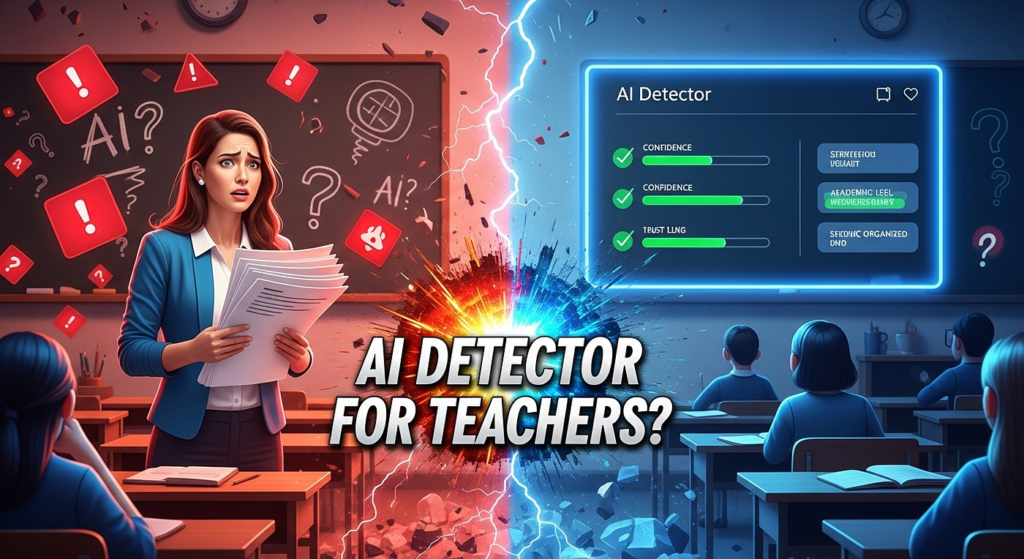
Walk into any staff room in 2026 and you’ll hear some version of the same conversation. A teacher pulls up an essay that reads a little too smooth, a little too even, and turns to whoever’s next to them. Does this feel off to you too? That gut check used to be pretty much the whole system. Now it’s just where things start.
AI writing tools got good fast. Faster than anyone in a school district could really keep up with, honestly. Students didn’t wait around for a policy memo either. By the time most schools got around to putting something in writing about chatbots in the classroom, kids had already been using them for a semester, sometimes two. So teachers did the thing teachers usually end up doing when the ground shifts under them without warning. They adapted on the fly. Quietly, mostly through trial and error, figuring out what worked as they went along. AI content detectors ended up part of that toolkit, not because anyone’s especially fond of them, but because grading fairly means having some way to notice when a student’s own voice has gone missing from their own paper.
This isn’t really a story about catching cheaters. It’s more a story about what grading fairness actually asks of a teacher when half the class has access to something that can churn out a decent five-paragraph essay in under ten seconds.
Why Detection Became Part of Grading, Not Separate From It
A few years ago, checking for academic honesty was something that happened after a teacher already got a bad feeling about a paper. These days it’s just baked into the process, running quietly in the background the way spell-check does, mostly unnoticed until something gets flagged.
Some of it comes down to scale, plain and simple. A high school English teacher with five sections of thirty kids can’t sit down and talk through every single essay one-on-one; there just aren’t enough hours in a week for that, not with lesson planning and everything else piled on top. And some of it’s fairness in a blunter sense. If one kid wrote every sentence themselves and another leaned hard on a chatbot for structure and phrasing, and they both walk away with the same grade, something’s off. Detection tools hand teachers a data point they didn’t used to have. Not a verdict. Just a data point, one piece among several others that already existed long before AI showed up, things like a student’s earlier essays, their in-class writing samples under timed conditions, notes from group discussions where you can hear how a kid actually thinks through an argument out loud.
The teachers who handle this well tend to treat a detection result about the way they’d have treated a Turnitin plagiarism score a decade ago. It’s evidence, weighed against everything else they already know, not a replacement for it. Nobody serious fails a student off one number by itself. That would be lazy grading, not fair grading, and most teachers know the difference even when they’re stretched thin.
What a Typical Workflow Looks Like Now
Ask around, and most teachers seem to have landed on something close to a three-part check, especially for the assignments that carry real weight: research papers, take-home essays, anything that isn’t written under supervision.
It usually starts with a plain read. Before any software gets involved, the teacher just reads the paper the way they’d read anything else, listening for whether the voice matches the kid who turned in the last draft, or the one who talks in class. This step alone catches a surprising number of obvious mismatches, long before a detector ever enters the picture. From there, if something feels worth checking, the paper goes through a detection scan, which flags sections where the word choice or sentence rhythm looks unusually flat or repetitive compared to typical student writing. And then, if a section does get flagged, the last part is just a conversation. The teacher sits down with the student, points to what came up, and asks them to talk through it.
That conversation part is the one people underrate the most. A flagged paper isn’t an automatic zero in classrooms that handle this well, not even close. It’s more like an invitation to talk for two minutes, and those talks tend to say a lot on their own. A student who actually wrote the thing can usually explain their own choices without much trouble, why they picked a particular example, why the argument goes in a certain order, what they were trying to do in the conclusion. A student who didn’t write it often can’t, and that gap between “can explain it” and “can’t explain it” tells a teacher more than any percentage score ever could.
The Fairness Problem Nobody Talks About Enough
Here’s the part that gets glossed over more than it should. These tools flag some student writing that was never AI-generated in the first place, and the students who get caught in that net tend to be the ones whose natural style runs more formal, more repetitive in structure, or came out of learning academic English as a second language. A kid who picked up formal academic writing later in life, maybe through ESL instruction or just a household where English wasn’t the first language spoken at home, sometimes lands in patterns a detector associates with AI generation, mostly because both share a kind of evenness that has nothing to do with honesty. Neurodivergent students can run into something similar too, since some writing patterns linked to autism or ADHD also tend to read as unusually structured or repetitive to a detector that’s only trained to spot statistical smoothness, not the reason behind it.
This is exactly why teachers who use these tools well leave room for a false flag. If a detector lights up on a paper and the student can walk through their own argument, point to specific choices, mention an earlier draft they’d scribbled notes on, that’s usually enough to clear it up. The tool starts a conversation. It was never meant to end one, and treating it like a final answer is where a lot of the backlash against these tools comes from in the first place.
It’s also part of why some teachers now build small checkpoints into longer assignments instead of just grading a finished product cold. Asking for an outline partway through, or a rough draft with a few margin notes, or even a quick one-on-one conference before the final paper is due. Not out of suspicion exactly, more that it builds a paper trail that makes the whole thing more transparent, including for students who genuinely didn’t touch AI and would rather prove it with a page of notes than sit through an awkward meeting after the fact.
Where Paraphrasing Tools Complicate Things
Detection’s gotten messier as students have started running AI-written drafts through paraphrasing software before turning them in, which shuffles the sentence structure enough to knock a detection score down or dodge it altogether. That’s not always someone being sneaky, to be fair. A lot of students use a paraphrasing tool the same way they’d reach for a thesaurus, to vary a word or clean up a clunky sentence in something they actually wrote themselves. That’s always been a normal part of writing, long before any of this AI conversation started.
The problem is the same tool can just as easily smooth over text that’s fully AI-generated, and a teacher reading the final product has no clean way to tell which situation they’re staring at. A paraphrased AI draft and a lightly polished human one can end up looking almost identical on paper, similar sentence variety, similar word choice, similar everything a detector is trained to measure. Which is one more reason a detection result works best as one clue among several, not a standalone verdict. A teacher who’s read a kid’s writing across a whole semester, seen their handwriting on a rough outline, heard them argue a point out loud in class discussion, just has context a single scan never will.
How Detectors Actually Work, in Plain Terms
Most teachers don’t need to know the statistics behind an AI content detector to use one reasonably. But knowing roughly how it works helps explain why the results aren’t always clean.
These tools mostly look at two things. How predictable the word choices are, which researchers call perplexity, and how much sentence length and rhythm shift across a passage, usually called burstiness. Human writing tends to wobble a bit. A short sentence, then a long one, then an odd word choice a language model would rarely reach for, maybe a bit of slang, a fragment, a sentence that trails off before picking back up. AI-generated text tends to stay smoother, more statistically average the whole way through, sentence after sentence sitting in a fairly narrow range of length and predictability. Detectors are built to notice that smoothness and flag it, usually returning some kind of percentage likelihood rather than a flat yes or no.
That’s a genuinely useful signal. It’s not a fingerprint, though. A tired kid rushing an essay the night before it’s due might come out flatter and more predictable than usual on a good day, simply because rushed writing tends to lean on safer, more common phrasing. A confident writer might turn in something unusually polished and get flagged for entirely the wrong reason. Detectors also tend to get less reliable on shorter pieces of writing; a single paragraph doesn’t give the underlying statistics much to work with, so a lot of teachers know to weigh a flag on a two-page essay more heavily than one on a three-sentence reading response. Keeping all of that in mind is what stops a teacher from treating a score like a lie detector reading, and keeps the follow-up conversation grounded in “let’s talk about this” instead of “you’re caught.”
What This Looks Like for Students
For students, the practical upshot is pretty simple. Process matters more than it used to. Keeping drafts around, jotting down notes as you go, being able to explain why a paragraph is built the way it is, all of that has quietly turned into a kind of insurance against a false flag. It’s also just decent writing practice regardless of what tools exist, the kind of habit that helps on a college application essay just as much as it helps clear up a misunderstanding with a tenth-grade English teacher.
Some students have started keeping their work in Google Docs specifically because of the version history, since it shows a paper being built up over several sittings rather than pasted in all at once. Others just save their outline and a rough draft in the same folder as the final paper, so if a conversation ever comes up, there’s something concrete to point to. None of this is required anywhere, but it’s become a quiet, sensible habit for a lot of students who’d rather avoid the conversation altogether than have a great answer ready for it.
Teachers, for their part, seem to be settling into something a lot more measured than the panic of the last couple of years suggested it might become. Detection isn’t running the classroom. It’s one input sitting next to a teacher’s own read of a paper, and a short conversation when something doesn’t quite add up. That combination, imperfect as it clearly is, is roughly what fair grading looks like right now, and probably for a while yet, at least until the tools and the norms around them settle into something steadier than what exists today.